Factory Specs & Quotes
Get unbranded (white-label) PDF datasheets and custom MOQ options directly from our engineering team. Fast 24-hour response. 100% Privacy Guaranteed. No spam.

Balancing a heavy-duty 240W power budget with SFP fiber uplinks in harsh, unconditioned environments without localized packet drop.
⚠️ The Project Manager's Dilemma
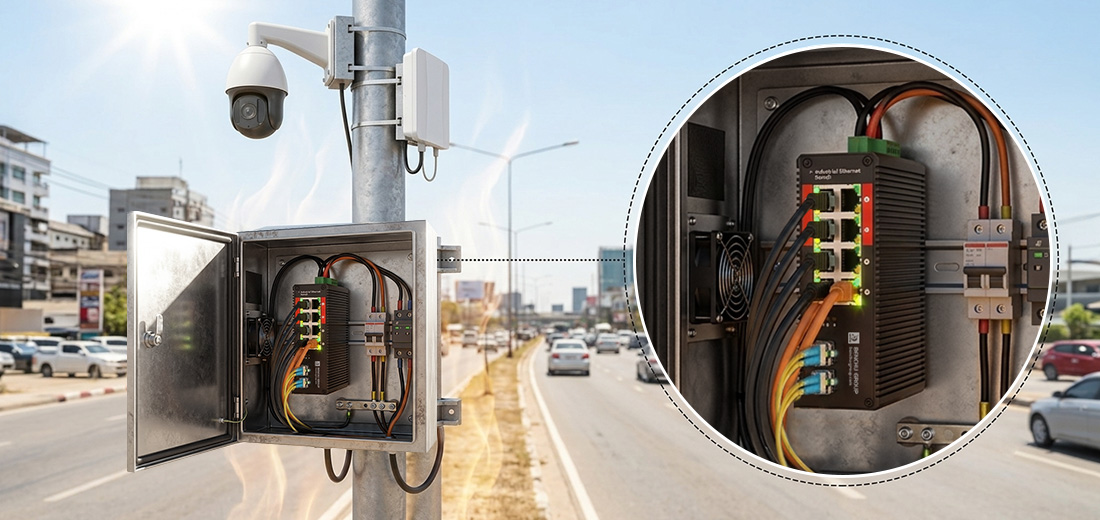
You deploy heavy-duty outdoor wireless access points, multi-sensor PTZ tracking cameras, and localized IoT computing nodes at the remote edge. On paper, your power budget is secure. Yet, during peak mid-day summer temperatures, the high-speed SFP optical uplinks mysteriously reset, or adjacent cameras experience sudden, unexplained reboots. You are not dealing with a software bug—you are facing a strict engineering crisis where extreme electrical power delivery directly threatens high-speed data integrity.
Deploying high-capacity power at the network edge involves solving a strict thermal and electrical equation. As multi-sensor PTZ cameras, heavy-duty outdoor wireless access points, and localized IoT computing nodes push standard power limits, the compact 8-Port PoE++ Switch has emerged as the definitive standard for localized edge distribution. However, engineering a hardware platform that simultaneously delivers a ruggedized 240W total power budget while maintaining structural signal integrity across high-speed SFP optical uplinks requires careful architectural balance. Without strict isolation protocols, the high thermal loads generated by maximum power distribution will rapidly degrade data backhaul performance.
A 240W power budget in an 8-port infrastructure creates a complex allocation challenge when deploying true IEEE 802.3bt Type 4 (up to 90W per port) hardware. While budget-engineered switches rely on basic flat sheet-metal shells that trap heat and create severe thermal choke points, an industrial platform requires a robust architecture to survive peak loading conditions.
An absolute budget of 240W means that the switch cannot simultaneously supply 90W across all eight ports. True industrial engineering solves this via advanced firmware microcode that manages power delivery intelligently across different edge devices:
By using an IP40 Aluminum Enclosure equipped with integrated heavy-duty thermal fins, heat is actively drawn away from the internal power rail. Furthermore, utilizing 100% full-shielded RJ45 ports provides dedicated grounding to block surges and prevent adjacent low-power channels from unexpected dropped data packets or sudden device reboots.
| Hardware Subsystem | Budget-Engineered Shortcuts | Benchu Industrial Design |
|---|---|---|
| Enclosure & Cooling | Flat sheet-metal shell; zero thermal fins, traps high heat rapidly. | IP40 Aluminum Enclosure with integrated heavy-duty cooling fins. |
| Port Shielding | Standard unshielded plastic ports; vulnerable to high-current noise and EMI. | 100% Full-Shielded ports with dedicated structural grounding. |
| Isolation Barrier | Shared ground lines; raw power spikes bleed straight into SFP backplane. | 6kV Optic/Electrical isolation barrier protecting data components. |
The most critical vector in high-power edge networking is the electrical connection between raw power supply lines and optical backhaul components. When an 8-port switch handles a continuous 240W workload, inferior architectures risk total failure due to unregulated energy routing. Securing high-speed fiber transmission under maximum thermal load requires three essential hardware pillars:
Standard commercial models route raw 60-90W unregulated power through lines that share grounding paths with data components. When a spike occurs, this layout bleeds current directly into the plastic ports, resulting in immediate power loss and unstable backhaul performance. Industrial engineering deploys a 6kV full galvanic isolation barrier (Optic/Electrical) that sits directly between the power circuits and the data core, blocking transient threats entirely.
Instead of blindly pushing high current down the lines—which can damage components and trigger system failures—true industrial-grade hardware utilizes dedicated 802.3bt smart silicon microprocessors. This chip runs an intelligent hardware handshake that reads signature resistance before releasing a single watt, ensuring highly stable power delivery even under full 240W concurrent operation.
By combining smart silicon management with an aluminum heat-sink body, the system operates flawlessly at extended thermal extremes. True industrial edge switches guarantee absolute packet stability and zero data drops even when localized ambient housing temperatures reach 85°C, ensuring that the high-speed SFP fiber backhaul link remains locked and operational.
Investing in an 8-port PoE++ platform engineered to properly balance a 240W budget with optical backhaul delivers direct, measurable advantages to enterprise field operations:
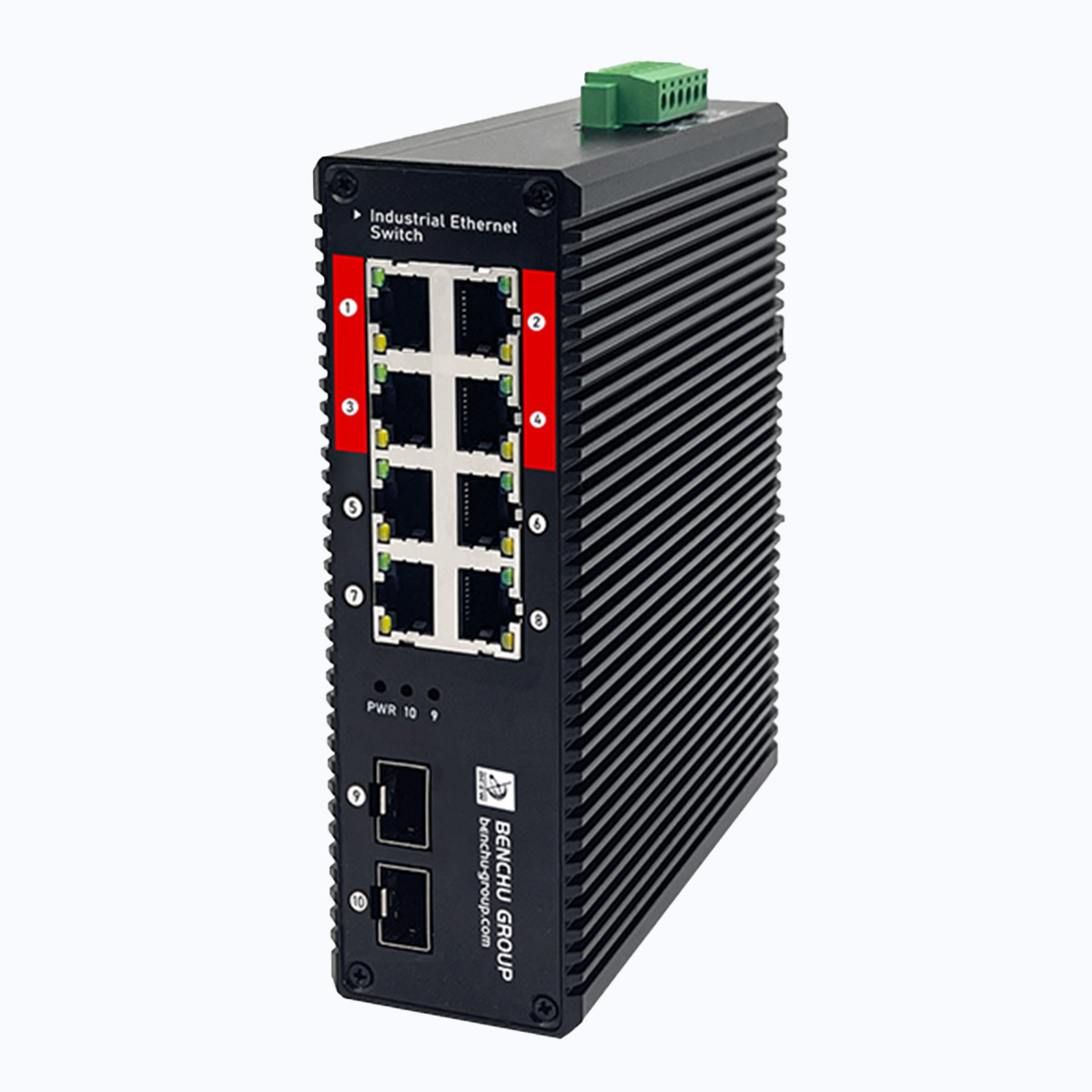
8-Port Gigabit Industrial PoE++ Switch with 2 Gigabit SFP Uplink
Don't let unmanaged thermal stress compromise your fiber backhaul integrity. Contact Benchu Group’s engineering team today for full laboratory validation data, complete physical schematics, and tailored project-level quotes.
 راسلنا عبر البريد الإلكتروني
 اتصل بنا
 عنوان
عنوان
5F, Block5, GuangmingGu Industrial Park, Matian Villiage, Guangming Disitrict, Shenzhen, China



 شبكة IPv6 المدعومة
 بالعربية