Factory Specs & Quotes
Get unbranded (white-label) PDF datasheets and custom MOQ options directly from our engineering team. Fast 24-hour response. 100% Privacy Guaranteed. No spam.

Selection Metric: DIN-Rail Industrial Switches (typically 4–16+ ports with 35mm EN 50022 mounting) are optimized for decentralized edge deployments inside control cabinets, outdoor enclosures, and machine-level automation systems. Their compact design, fanless thermal management, and wide operating temperature range (-40°C to +75°C) make them suitable for high-vibration industrial environments. In contrast, Rackmount Industrial Switches (commonly 16–48+ ports with 19-inch EIA-310-D mounting) are designed for centralized network aggregation in control rooms, substations, and industrial data centers. They provide higher port density, larger fiber backbone capacity, and easier integration into structured rack-based network architectures.
For an Industrial Switch deployment, control cabinet space availability directly influences the optimal form factor, affecting cable routing, connector orientation, heat dissipation, and maintenance accessibility.
DIN-Rail Industrial Switches are vertically mounted on standard 35mm DIN-Rails (EN 50022), minimizing horizontal footprint inside NEMA/IP-rated field enclosures and machine control cabinets. Their front-access RJ45 and SFP interfaces simplify installation, but sufficient door clearance is required to maintain proper copper and fiber cable bend radius and prevent mechanical stress on connectors.
Rackmount Industrial Switches use horizontal 19-inch 1U/2U chassis designs for centralized installation in industrial racks, control rooms, and network cabinets. Their higher port density (commonly 16–48+ ports depending on model configuration) requires structured cable management to maintain airflow, simplify maintenance access, and support scalable fiber and copper uplink connections.
Operating temperature ratings, thermal management methods, and mechanical durability requirements differ significantly between DIN-Rail and Rackmount Industrial Switch designs.
Key hardware parameters determine whether an Industrial Switch is better suited for decentralized field nodes or centralized aggregation environments:
| Specification | DIN-Rail Industrial Switch | 19-Inch Rackmount Industrial Switch |
|---|---|---|
| Form Factor | 35mm DIN-Rail (EN 50022) mounting | 19-inch EIA-310-D rack chassis (1U/2U/4U) |
| Port Density Range | 4-16+ Gigabit Ethernet ports with optional SFP uplinks | 16-48+ Gigabit ports with higher-capacity fiber uplinks |
| Cooling Mechanism | Fanless passive thermal design for harsh environments | Active fan-assisted cooling or enhanced chassis ventilation |
| Power Input Interface | DC terminal block input (12V/24V/48V DC, optional redundancy) | Internal AC power supply or industrial DC power options |
| PoE Power Capability | Edge-level PoE delivery with IEEE 802.3af/at/bt support up to 90W/port | Higher centralized PoE budgets for multi-device aggregation |
| Primary Deployment Topology | Decentralized field networks, machine cells, and control cabinets | Centralized aggregation, backbone, and distribution networks |
In general, DIN-Rail switches prioritize ruggedness, compact installation, and edge connectivity, while rackmount switches focus on port density, centralized management, and network aggregation.
Selecting the correct Industrial Switch form factor requires matching cabinet space, network architecture, power availability, and environmental conditions with the appropriate hardware design.
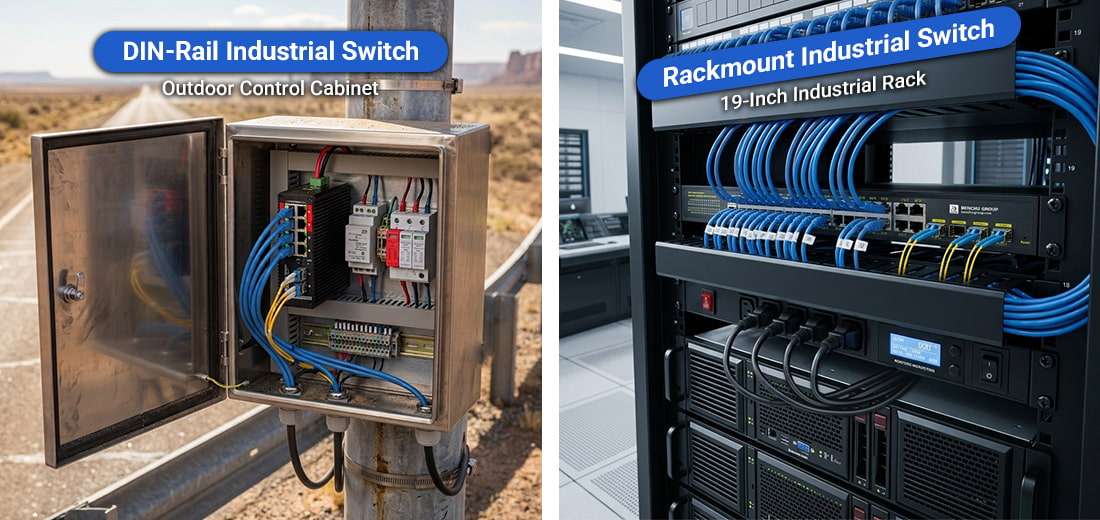
DIN-Rail vs. Rackmount Industrial Switch deployment: edge connectivity inside field cabinets compared with centralized aggregation in 19-inch industrial racks.
The primary differences are form factor, installation location, and network role. DIN-Rail Industrial Switches are compact solutions mounted on standard 35mm DIN-Rails inside control cabinets for edge connectivity. Rackmount Industrial Switches use 19-inch chassis designs with higher port density for centralized aggregation in control rooms and industrial network cabinets.
Choose a DIN-Rail Industrial Switch when cabinet space is limited, harsh environments require fanless operation, and equipment is exposed to vibration or extreme temperatures (-40°C to +75°C). They are commonly installed near PLCs, sensors, and field devices using DC terminal block power inputs.
Yes. Many DIN-Rail industrial switches feature built-in Power over Ethernet (PoE/PoE+/PoE++) capabilities, supporting IEEE 802.3af/at/bt standards up to 90W per port. This allows them to power high-draw field devices directly over Ethernet cabling without requiring extra power adapters in remote enclosures.
Yes, they are often combined in hierarchical networks. DIN-Rail switches connect edge devices such as machines, PLCs, and cameras, while Rackmount switches provide centralized aggregation through copper or fiber uplinks.
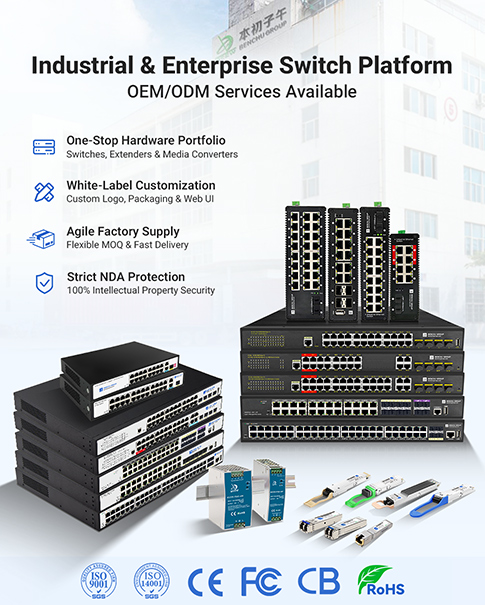
As a trusted manufacturer in industrial networking, Benchu Group provides reliable DIN-Rail and Rackmount Industrial Switch platforms for automation and harsh environments. We offer flexible OEM/ODM customization services—from tailored PCB design and custom port configurations to private label enclosure branding—ensuring complete alignment with your project requirements.
Explore OEM/ODM Industrial Switch Solutions → راسلنا عبر البريد الإلكتروني
 اتصل بنا
 عنوان
عنوان
5F, Block5, GuangmingGu Industrial Park, Matian Villiage, Guangming Disitrict, Shenzhen, China



 شبكة IPv6 المدعومة
 بالعربية