Choosing the Right Managed PoE Switch: L2+ vs L3 48-Port Comparison Guide
Aug 05, 2026
How to Choose a PoE Switch: L2+ vs L3 Managed
Choosing the optimal managed network switch requires aligning network topology with environmental and power demands. For harsh outdoor deployments like intelligent transport, oil & gas, and perimeter security requiring -40°C to 75°C wide-range temperatures, L2+ Managed Switch with static routing, ERPS ring protection, and 6KV Surge Protection dominate. Enterprise backbones requiring dynamic routing (OSPF/RIP) should leverage L3 Managed Switch alongside 90W PoE++ and Redundant Power Inputs.
🔌 Managed Network Switch ⚡ 90W PoE++ & Redundant Power 🚀 L2+ vs L3 Managed Switch 🛡️ -40°C to 75°C Wide Temp
Architecture Selection: Align your network deployment by comparing L2+ (Static Routing) and L3 (Dynamic Routing like OSPF/RIP) models based on density and traffic control needs.
Environmental Hardening: Industrial-grade switches feature -40°C to 75°C wide temperature tolerance, 6KV surge protection, and Din-Rail/wall mounting for harsh outdoor cabinets.
High-Power Delivery: Ensure robust power delivery for PTZ cameras and APs utilizing IEEE 802.3bt 90W PoE++ and Redundant Power Inputs (48-55VDC).
1. What Are the Core Architecture Differences Between L2+ and L3 Managed Switches?
Procuring a managed network switch involves a comprehensive managed PoE switch comparison between software capabilities and hardware hardening specifications. Evaluating an L2+ vs L3 Managed Switch architecture ensures proper deployment across various environments:
L2+ Managed Switch: Combines full L2 features with Static Routing and industrial ERPS ring protection for sub-second failover. The go-to choice for industrial security and transportation edge networks.
L3 Managed Switch: Integrates high-speed switching with IP routing engines, supporting OSPF, RIP, and multi-subnet segmentation for enterprise core and aggregation layers.
2. How Do Specifications Compare Between L2+ and L3 Managed PoE Switch Tiers?
Below is an objective technical comparison matrix for managed switches across L2+ and L3 tiers:
Technical Dimension / Parameter
L2+ Managed PoE Switch
L3 Managed PoE Switch
Routing Capability
Static Routing (Inter‑VLAN)
Dynamic Routing (OSPF, RIP, VRRP)
Operating Temperature
Industrial Wide‑Temp: -40°C to 75°C
Commercial/Industrial: 0°C to 50°C / -40°C to 70°C
Surge & Protection
6KV Surge Protection / IP40 Metal Housing
6KV Surge Protection / Enterprise Chassis
High Availability & Ring
ERPS Ring (Industrial Millisecond Failover)
ERPS Ring, VRRP Redundancy Backup
PoE Standard & Budget
IEEE 802.3af/at/bt, Up to 90W PoE++ (240W Budget)
IEEE 802.3af/at/bt, Up to 90W PoE++ (High Power)
Power Inputs & Mounting
Redundant Power Inputs (48-55VDC), Din-Rail / wall
Redundant Power Options, Rack / Cabinet Mount
Uplink & Reliability
Gigabit SFP Slots (> 500,000h MTBF)
Gigabit / 10G SFP+ Slots (> 500,000h MTBF)
Product Overview: Benchu SP7500‑48PGE4TF‑L3M & SP7500‑48PGE4GF‑L2M
Explore our high‑density managed PoE switch options, available for sample testing and OEM bulk orders:
HIGH‑DENSITY MANAGED POE SWITCH
48 Port Full Gigabit Managed PoE Switch With 4 Gigabit SFP Uplink
Model: SP7500‑48PGE4GF‑L2M
High‑Density Configuration: 48×10/100/1000Mb RJ45 PoE+ ports, total power budget up to 500W for PTZ cameras, outdoor APs and surveillance endpoints.
Uplink Connectivity: 4×1G SFP fiber uplink slots for long‑distance industrial ring networking.
L2+ industrial feature: Full L2 suite plus IPv4/IPv6 static routing, ERPS millisecond ring protection, VLAN, QoS, LACP, IGMP, MSTP.
Industrial & Manageability: Wide‑temp hardware, Din‑Rail mount, secure SSH/ACL/802.1X, supports WEB / CLI / SNMP management.
GET DATASHEET & PROJECT QUOTE →
HIGH‑DENSITY MANAGED POE SWITCH
Managed 48 Port Gigabit PoE Switch With 4‑10Gb SFP+ Uplink
Model: SP7500‑48PGE4TF‑L3M
High‑Density Configuration: 48×Gigabit PoE+ ports, up to 500W total power budget for IP cameras, enterprise APs and IP terminals.
Uplink Connectivity: 4×1G/2.5G/10G SFP+ high‑speed uplink slots for enterprise core aggregation.
Layer3 Routing: Full L3 routing stack: static routing, OSPF, RIP, VRRP for multi‑subnet enterprise segmentation.
Security & OEM: VLAN/QoS/ERPS plus SSH, ACL, AAA, 802.1X/RADIUS/TACACS+; supports white‑label OEM/ODM customization.
GET DATASHEET & PROJECT QUOTE →
3. What Are the Ideal Deployment Scenarios for Each Switch Type?
Intelligent Transportation Systems (ITS) & Oil/Gas: Roadside or hazardous cabinets demand extreme thermal tolerance, vibration resistance, and lightning protection. Choose an L2+ Managed Switch with -40°C to 75°C range, Din-Rail mounting, 6KV Surge Protection, and Redundant Power Inputs.
Perimeter Security & Campus Surveillance: Long‑distance outdoor fence runs with fiber uplinks benefit from L2+ Managed Switches featuring static routing and ERPS ring self‑healing to prevent video feed drops.
Enterprise Office & Multi‑Subnet Workspaces: Climate‑controlled office environments requiring high‑speed cross‑subnet communication and multi‑department segmentation should utilize L3 Managed Switches.
4. How to Navigate Key Procurement Factors and Avoid Common Pitfalls?
PoE Power Budgets & High‑Draw Devices: Always calculate cumulative power consumption under full load (e.g., verifying 90W PoE++ support via IEEE 802.3bt) to safely power PTZ cameras or high‑performance APs without system reboots.
Over‑Provisioning Risks: Avoid blindly choosing L3 for single‑subnet setups, which unnecessarily inflates hardware expenses and configuration complexity; L2+ static routing is sufficient for most outdoor edge surveillance networks.
Ignoring Redundancy: Overlooking ERPS ring protocols in outdoor security runs can leave networks vulnerable to extended downtime from single‑point fiber cuts.
5. Frequently Asked Questions (FAQ)
Q1: What is the core difference between L2+ and L3 managed PoE switches?
A: L2+ managed switches support static routing exclusively for local inter‑VLAN communication, whereas L3 managed switches support dynamic routing protocols such as OSPF and RIP, making them suitable for complex multi‑subnet enterprise networks.
Q2: When should I deploy an industrial wide‑temperature switch with -40°C to 75°C tolerance?
A: Deploy industrial wide‑temperature switches with -40°C to 75°C range, Din-Rail mounting, and 6KV Surge Protection in harsh outdoor environments such as intelligent traffic systems, oil & gas fields, and perimeter security surveillance. Most suitable models are L2+ managed PoE switches.
Q3: Is an L3 switch necessary for outdoor PoE surveillance applications?
A: In most outdoor edge‑access PoE scenarios, an L3 switch is unnecessary. L2+ static routing and VLAN capabilities fully suffice. L3 is typically reserved for small independent subnet cores or multi‑subnet aggregation nodes.
Q4: How does 90W PoE++ impact switch selection?
A: IEEE 802.3bt 90W PoE++ capability requires verifying that the total PoE power budget (often supported by Redundant Power Inputs like 48‑55VDC) can handle high‑draw endpoints like PTZ cameras and high‑performance wireless access points. Both L2+ and L3 platforms support this specification.
6. How to Contact Us for Custom OEM/ODM Solutions?
Looking for L2+ / L3 Managed PoE Switch or Custom OEM/ODM Solution?
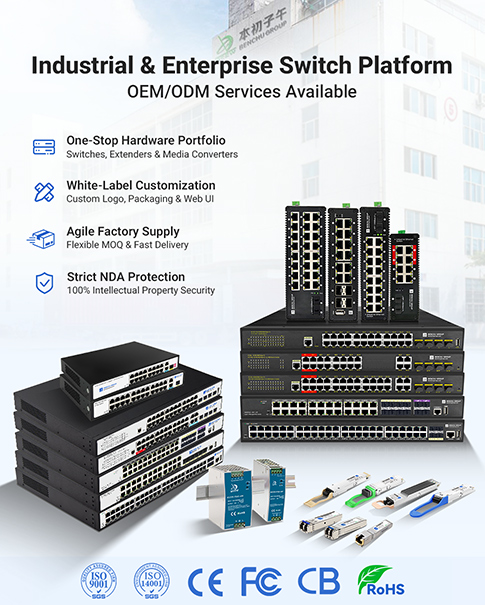
Sourcing industrial switches or planning your private‑label network switch lineup? Contact our hardware engineers. We provide complete technical datasheets, support evaluation sample testing, competitive factory‑direct pricing, and fully customized OEM/ODM managed PoE switch solutions. Hardware modification, Web UI branding, firmware tuning, logo and packaging rebranding are all available to meet your commercial and industrial networking project demands.
REQUEST SWITCH DATASHEET & ODM QUOTE →
Facebook LinkedIn Pinterest Reddit VK X Telegram
🔒 Legal Disclaimer: All technical specifications, comparisons, and naming conventions are provided for engineering evaluation and educational guidance under Fair Use principles. Product configurations are subject to change based on custom OEM/ODM requirements.
{
"@context": "https://schema.org",
"@type": "TechArticle",
"headline": "How to Choose a PoE Switch: L2+ vs L3 Managed",
"description": "Comprehensive selection guide for managed network PoE switches, comparing L2+ vs L3 managed switch options, managed PoE switch comparison specs, 90W PoE++, Din‑Rail, and -40°C to 75°C industrial wide temperature hardware for surveillance, ITS and enterprise networks.",
"author": {
"@type": "Organization",
"name": "Benchu Group"
},
"publisher": {
"@type": "Organization",
"name": "Benchu Group"
}
}
إقرأ المزيد