Can an Unmanaged 10Gbps PoE++ Switch Handle 4 Channels of Simultaneous 90W Full Load?
Jul 01, 2026
🚀 Direct Answer for Network Engineers: Yes, but only if the hardware architecture utilizes a dedicated 300W high-density power pool combined with industrial-grade thermal management. While commercial ethernet switch throttle power when multi-channel peak loads occur, a premium engineered 10Gbps unmanaged switch built on hardware-level auto-sensing logic can continuously sustain 75W–90W of IEEE 802.3bt Type 4 power simultaneously across 4 downlink ports without dropping a single data packet.
The Physics of Power Density: Demystifying the 300W PoE Pool
💡 Summary: Sustaining four concurrent channels of 90W Ultra PoE++ requires strict mathematics. Without an exact overhead power budget, systemic voltage drops will cause remote device reboots.
From a hardware research perspective, delivering maximum power injection under full load is an exercise in power density optimization. When an enterprise deploys power-hungry hardware—such as Wi-Fi 7 AP arrays, multi-sensor PTZ IP cameras, or standalone edge AI inference nodes—the network hub experiences massive thermal and electrical stress.
If a switch claims 90W per port but only features a 120W or 180W total power budget, it relies on "dynamic power allocation," meaning it will severely throttle ports as soon as a second or third device requests maximum power. True concurrent delivery demands a verified 300W total power budget. This deep power pool guarantees that even when four high-density devices draw peak wattage simultaneously, the physical layer maintains uniform power distribution across all channels.
Eliminating the Software Overhead: Why "Unmanaged" Means Lower Latency
💡 Summary: Stripping away the complex operating systems of managed switches eliminates firmware vulnerability risks and software-induced packet delay during high-throughput workloads.
A common misconception among system integrators is that high-power networks require managed switches to handle heavy traffic loads. In localized micro-clusters, such as an all-flash NVMe NAS environment or an isolated media production bay, software-managed protocols introduce configuration latency and processing overhead.
🔌
Plug-and-Play Simplicity
Bypasses complex IP assignments and subnet mapping entirely. Ready right out of the box.
⚡
160 Gbps Fabric
Pure hardware logic routes heavy data lines at absolute wirespeed with zero packet buffering.
🛡️
Zero OS Vulnerabilities
No firmware update lags, no operating system crashes, and absolute immunity to network-level hacks.
Hardware Benchmark Checklist for Full Load Verification
💡 Summary: B2B procurement teams must audit specific physical architecture specs to ensure an unmanaged 10G switch can endure continuous high-wattage stressors.
Critical Hardware Pillar
Technical Requirement for 4x90W Load
System Benefit
PoE Compliance
IEEE 802.3bt Ultra PoE++ (Type 4)
Hardware auto-sensing backward compatible with 802.3at/af devices.
Power Architecture
Internal Universal Module (AC 100V~240V)
Eliminates bulky external power bricks, reducing deployment space and failure points.
Thermal Framework
SECC Galvanized Metal + Active Fan Assembly
Guarantees optimal heat rejection across wide operating thresholds (-10°C to 50°C).
Switching Capacity
160 Gbps Fabric / 74.4 Mpps Forwarding
Provides unthrottled line-rate data aggregation back to the core via a dedicated non-PoE uplink.
Hardware Spotlight
5-Port 10Gbps Unmanaged PoE++ Switch
Model: SP5210-4PTE1TE-4BT
5-Port 10G Topology 802.3bt 90W Port 300W Budget
✓ Next-Gen Wi-Fi 7 Optimization: Purpose-built to unlock the maximum wireless capacity of enterprise Wi-Fi 7 APs.
✓ Ultra-HD 8K RAW Workflows: Deploys a dedicated multi-gigabit network matrix for creative micro-studios.
✓ Dedicated 10G Uplink Trunk: Features 4 x 10G PoE++ downlinks and 1 x standalone 10G Base-T uplink.
Access Specifications & Data Sheet ➔
Thermal Mitigation: Preventing Signal Degradation Under Full Load
💡 Summary: High wattage generates internal thermal spikes. Without industrial-grade galvanic casing and active airflow, copper transmission lines face intense impedance and packet loss.
When four ports draw close to 90W each over Cat6A Shielded Twisted Pair (STP) lines, electrical resistance naturally generates heat inside the RJ45 connectors and internal circuit boards. If a switch relies on passive plastic housing, the internal chipsets will rapidly exceed their thermal thresholds.
To preserve signal integrity and avoid impedance mismatches, high-power network gear requires a ruggedized SECC galvanized all-metal chassis paired with integrated high-efficiency cooling fans. Active ventilation ensures that the internal AC-to-DC universal power module stays cool, maintaining a rock-solid multi-gigabit network matrix even during 24/7 continuous peak-power operations.
Frequently Asked Questions
Q1: How does a switch safely deliver 90W without damaging lower-power PoE devices?
A1: Premium 802.3bt Type 4 switches integrate hardware-level auto-sensing and surge mitigation logic. The switch negotiates a precise power handshake with the connected device, delivering exactly what is requested and safeguarding the circuit against over-voltage.
Q2: What transmission media is mandatory for 10Gbps line-rate under full 90W PoE load?
A2: System engineers must utilize high-quality Cat6A, Cat7, or Cat8 Shielded Twisted Pair (STP) copper lines up to 100 meters. Standard unshielded Cat6 cables can suffer from alien crosstalk and severe heat accumulation when transmitting 10G data and high-density PoE simultaneously.
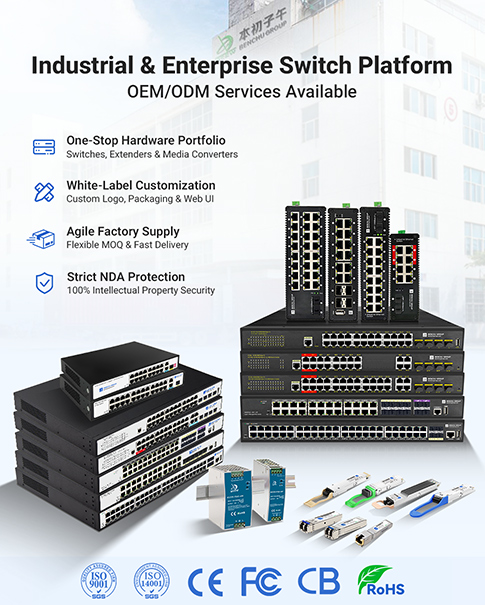
Accelerate Your Network Product Line with an Expert Shenzhen OEM/ODM Partner
Are you a global networking brand, security hardware distributor, or tier-1 system integrator searching for white-label multi-gigabit hardware? Benchu Group manufactures commercial and industrial-grade high-power network switches tailored to your exact specifications.
Contact Our Engineering Team for a Quote
document.addEventListener("DOMContentLoaded", function() {
var container = document.getElementById('productZoomContainer');
var img = document.getElementById('productZoomImage');
if (container && img) {
container.addEventListener('mouseenter', function() {
img.style.transform = 'scale(1.6)'; // 移入自动放大1.6倍
});
container.addEventListener('mousemove', function(e) {
var rect = container.getBoundingClientRect();
var x = e.clientX - rect.left;
var y = e.clientY - rect.top;
var xPercent = (x / rect.width) * 100;
var yPercent = (y / rect.height) * 100;
img.style.transformOrigin = xPercent + '% ' + yPercent + '%';
});
container.addEventListener('mouseleave', function() {
img.style.transform = 'scale(1)';
img.style.transformOrigin = 'center center';
});
}
});
إقرأ المزيد

 راسلنا عبر البريد الإلكتروني
 اتصل بنا
 عنوان
عنوان



 شبكة IPv6 المدعومة
 بالعربية