Factory Specs & Quotes
Get unbranded (white-label) PDF datasheets and custom MOQ options directly from our engineering team. Fast 24-hour response. 100% Privacy Guaranteed. No spam.

As heavy-duty edge applications—such as multi-sensor PTZ tracking cameras, outdoor Wi-Fi 7 base stations, and localized AI computing nodes—proliferate across municipal and industrial grids, the demand for high-capacity PoE++ Switch hardware has skyrocketed. However, this surge has triggered a dangerous influx of budget-engineered "commercial clones" into the B2B market. While these look-alike systems boast impressive 90W specifications on their marketing brochures, a rigorous technical audit frequently reveals severe structural shortcuts that compromise operational continuity in mission-critical field deployments.
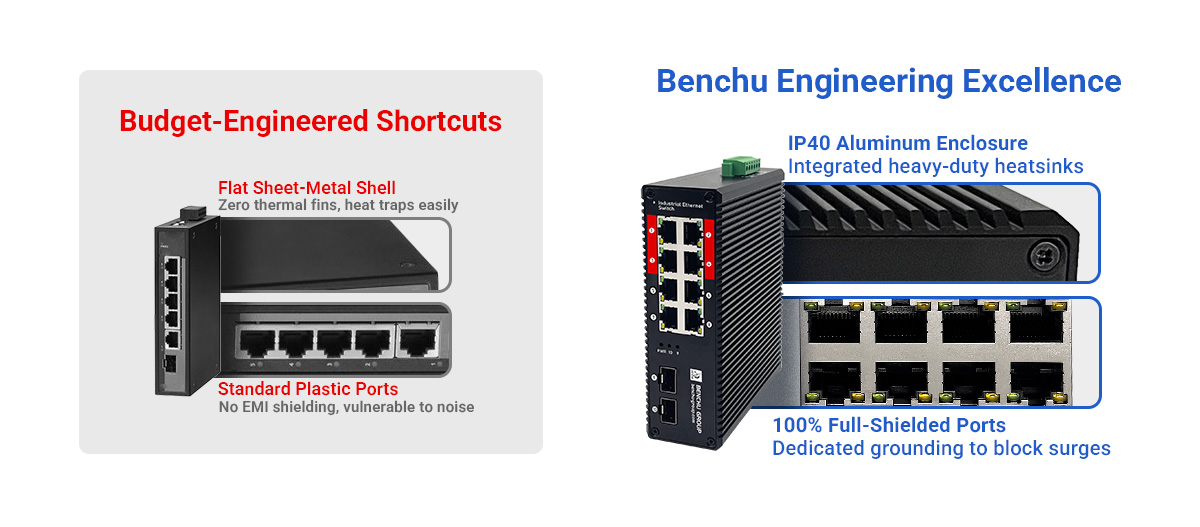
Commercial clones are essentially consumer-grade or light-enterprise desktop switches repackaged inside ruggedized sheet-metal enclosures. They utilize cheap, unisolated PSE (Power Sourcing Equipment) controllers and low-tier, commercial-grade electrolytic capacitors that degrade rapidly when subjected to real-world operational stress.
⚠️ Hidden Engineering Bottleneck: Shared Power Topologies
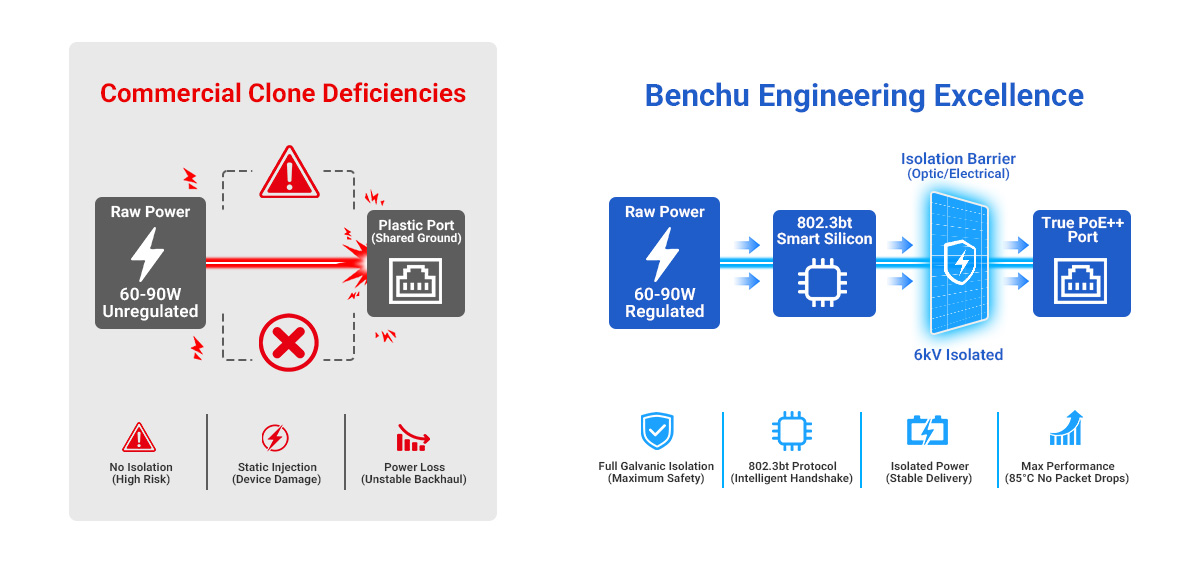
The most prevalent vulnerability lies in their shared power distribution topologies. A clone may claim compliance with the **IEEE 802.3bt standard**, but it lacks the dynamic power negotiation microcode and robust thermal pathways required to sustain a continuous 90W load across multiple ports simultaneously. When multi-channel high-power devices activate at the same moment, the total power pool undergoes critical instability.
Under full operational load, the voltage sags sharply below the 50V required for stable Type 4 PoE delivery. This causes the internal power rail to fluctuate violently, inducing high jitter in data packages and triggering uncommanded, cyclical device reboots that paralyze your remote edge networks precisely when stability is needed most.
| Hardware Subsystem | Commercial Clone Vulnerabilities | Benchu True 802.3bt Engineering |
|---|---|---|
| PSE Controller Silicon | Unisolated consumer chipsets; prone to cross-port thermal cascading. | Isolated, enterprise-grade PSE processors with independent port protections. |
| Power Handshake Protocols | Forced static voltage output; lacks hardware-level Layer 1 LLDP handshaking. | Dynamic 4-pair hardware classification with adaptive power negotiation. |
| Surge & Isolation Barrier | Minimal 1kV protection; shared grounding that risks multi-port destruction. | 6kV surge protection per port with 2.25kV DC electrical isolation. |
To protect your field infrastructure from premature failure and unexpected network downs, procurement teams and network engineers must look past superficial datasheet marketing. It is vital to execute an empirical, hardware-level verification audit focusing on three core industrial design pillars:
True IEEE 802.3bt hardware utilizes a precise, multi-stage hardware handshake before releasing Type 4 power up to 90W. It safely checks the signature resistance and capacitance of the Powered Device (PD) across four pairs of twisted copper wires. This intelligent classification protocol dynamically reads whether the device requires Class 5 through Class 8 power limits, continuously negotiating via LLDP (Link Layer Discovery Protocol) data blocks under active conditions.
Commercial clones frequently bypass this complex silicon negotiation. To save manufacturing costs, they rely on basic hardware injectors that force a static high voltage straight down the copper lines. This improper, unnegotiated power delivery creates massive risks: it can instantly fry legacy non-PoE hardware accidentally patched into the network, or overheat mid-power endpoints that are not engineered to withstand raw, unmanaged Type 4 energy feeds.
Industrial environments are heavily plagued by severe electromagnetic interference (EMI), variable ground loops, and high-voltage lightning transients. A genuine industrial-grade switch features heavy-duty electrical isolation barriers—often using high-grade optocouplers and dedicated transformers—that isolate the delicate core switching logic from the raw power delivery circuits.
When a cheap commercial clone suffers an outdoor lightning surge on an external PTZ camera copper line, it lacks the necessary per-port barriers to dump that excess energy safely to ground. Because the internal grounding plane is shared across all channels without true physical isolation, the transient pulse routinely cascades straight through the data backplane. The resulting chain-reaction short circuit instantly destroys the entire switch assembly, taking every other connected device down with it.
A high-power edge switch is only as reliable as its backhaul interface. When multiple high-draw devices pull heavy Type 4 wattage simultaneously, a massive amount of localized thermal dissipation is generated inside the switch housing. Genuine industrial architectures isolate these high-heat components from the sensitive data ports using advanced localized thermal barriers and distinct physical PCB separation.
Commercial clones, by contrast, squeeze all components together onto a single unshielded board. As full-load power operations bake the enclosure from the inside out, this uncontrolled heat conducts directly into the adjacent SFP optical transceiver slots. The excessive thermal stress shifts the operating laser wavelength of the SFP modules, leading to sudden, hard-to-diagnose fiber packet drops, high signal jitter, or absolute backhaul link disconnection that blinds the central control center completely.
Investing in a rigorously audited, true industrial platform ensures critical operational advantages and long-term lifecycle cost savings for network operators, municipal engineers, and systems integrators alike:
Protect your network edge from the hidden vulnerabilities of consumer-grade clones. Contact Benchu Group’s engineering team today for independent laboratory testing data, complete structural compliance records, and direct project-level pricing.
Request Technical Auditing Kit & RFQ راسلنا عبر البريد الإلكتروني
 اتصل بنا
 عنوان
عنوان
5F, Block5, GuangmingGu Industrial Park, Matian Villiage, Guangming Disitrict, Shenzhen, China



 شبكة IPv6 المدعومة
 بالعربية